Market Decode™: New Fed chair, new timeline on rates
With inflation remaining sticky, what’s next for interest rates, and what should investors know?
THE TRANSITION TO A NEW Federal Reserve Chair comes at a complex moment: higher bond yields, persistent inflation and ongoing global uncertainty. Recent data, including higher producer prices and rising energy costs, has pushed markets to recalibrate expectations, with BofA Global Research sliding potential rate-cut projections to late 2027.
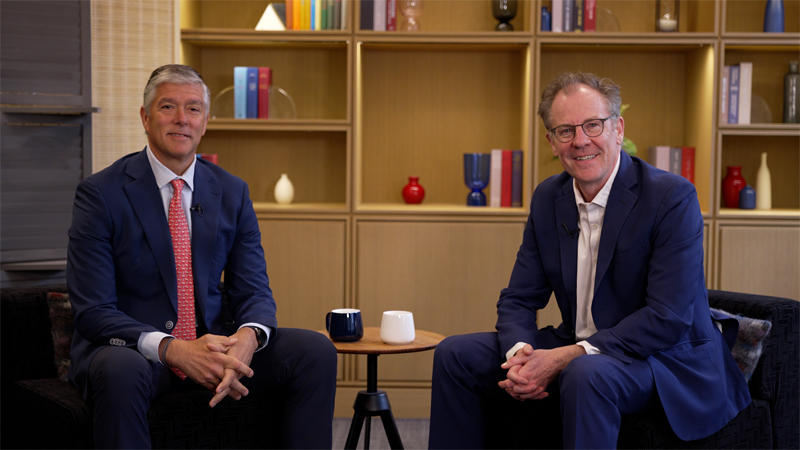
In the video above, Matthew Diczok, head of Cross Asset Market Strategy in the Chief Investment Office for Merrill and Bank of America Private Bank, breaks down some of the challenges facing the new Fed chair, an avowed dove, who has tended to favor lower interest rates. “While the conversation for weeks had been over when rate cuts may come, the shift is now to whether they’ll come at all, or if we may even see rate hikes,” Diczok notes.
Inflation risk and your portfolio
Diczok also shares insights on managing your portfolio, given the market’s revised rate expectations, and offers potential equity and fixed income strategies to consider. “Keep focused on long-term goals, stay diversified, manage inflation risk and use volatility to reassess — not react,” he says.
For more on the importance of staying the course, watch “Long-term investing: Core principles every investor should know.”
A Private Wealth Advisor can help you get started.


Important disclosures
The opinions expressed are as of 5/20/2026 and are subject to change.
Investing involves risk, including the possible loss of principal.
Past performance is no guarantee of future results.
Asset allocation, diversification and rebalancing do not ensure a profit or protect against loss in declining markets.
Investments have varying degrees of risk. Some of the risks involved with equity securities include the possibility that the value of the stocks may fluctuate in response to events specific to the companies or markets, as well as economic, political or social events in the U.S. or abroad. Investing in fixed-income securities may involve certain risks, including the credit quality of individual issuers, possible prepayments, market or economic developments and yields and share price fluctuations due to changes in interest rates. When interest rates go up, bond prices typically drop, and vice versa.
This information should not be construed as investment advice and is subject to change. It is provided for informational purposes only and is not intended to be either a specific offer by Bank of America, Merrill or any affiliate to sell or provide, or a specific invitation for a consumer to apply for, any particular retail financial product or service that may be available.
The Chief Investment Office (CIO) provides thought leadership on wealth management, investment strategy and global markets; portfolio management solutions; due diligence; and solutions oversight and data analytics. CIO viewpoints are developed for Bank of America Private Bank, a division of Bank of America, N.A., (“Bank of America”) and Merrill Lynch, Pierce, Fenner & Smith Incorporated (“MLPF&S” or “Merrill”), a registered broker-dealer, registered investment adviser and a wholly owned subsidiary of Bank of America Corporation (“BofA Corp.”).
BofA Global Research is research produced by BofA Securities, Inc. (“BofAS”) and/or one or more of its affiliates. BofAS is a registered broker-dealer, Member SIPC and wholly owned subsidiary of BofA Corp.