
Market Decode™: Renewables recharged?
After a breakout year for clean energy investment, are renewables poised to carry that momentum into 2026 — and what trends and risks should investors watch for now?
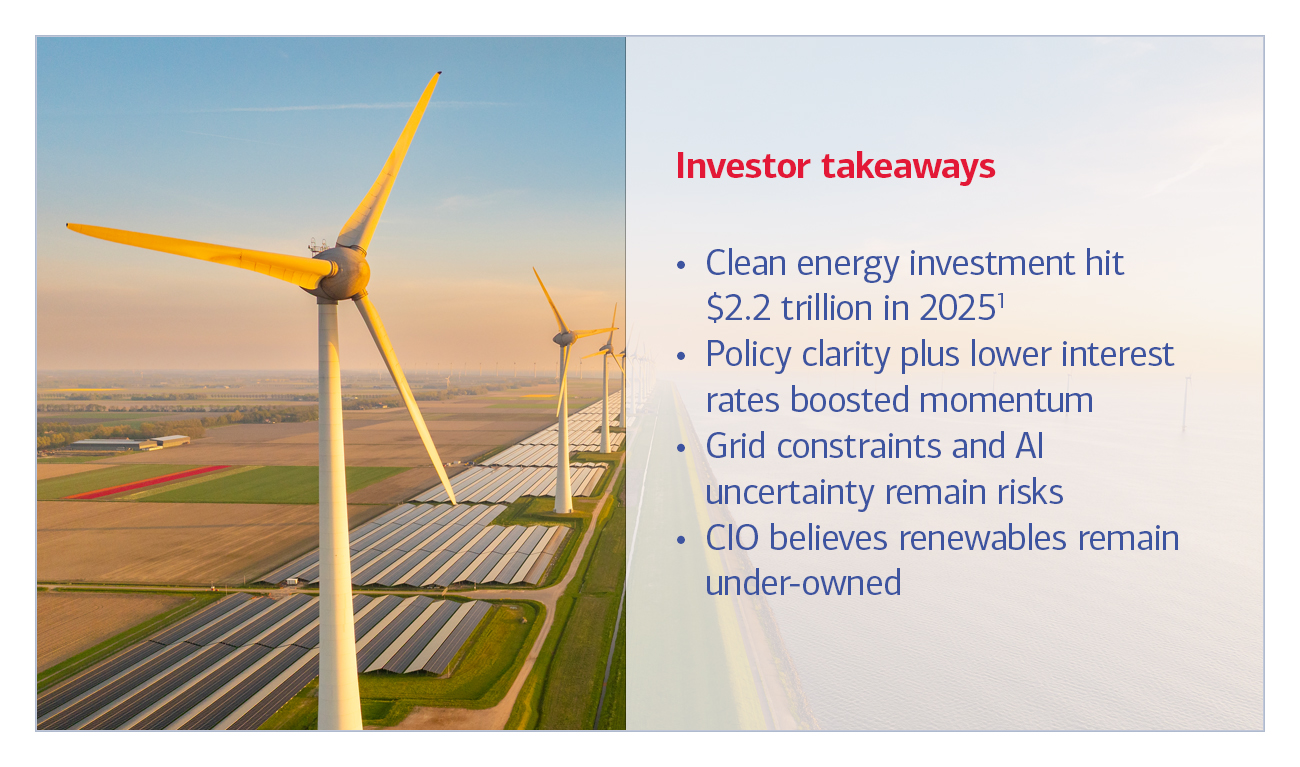
RENEWABLE ENERGY INVESTMENT hit $2.2 trillion in 20251, representing roughly two‑thirds of all global energy spending and marking a powerful boost in the sector’s momentum. Renewable energy stocks also outperformed broad energy and equity indexes for the year, fueled by gains across power generation, grid infrastructure, and clean tech equipment providers. “The demand for power globally has never been greater — and renewable energy is rising to help meet that demand,” says Anna Potts, investment strategist for the Chief Investment Office (CIO), Merrill and Bank of America Private Bank. Watch the video above for more on what’s behind renewables’ rise.
What are the drivers and risks impacting renewable energy?
“A mix of clearer‑than‑expected policy outcomes, a friendlier rate backdrop and intensifying AI‑driven power demand helped drive the turnaround,” explains Potts. But uncertainty remains, from grid bottlenecks to potential slowdowns in AI infrastructure buildout to upcoming policy decisions that could introduce volatility for U.S. deployment. Still, she notes: “Big picture, rising global power demand is a durable, multi‑year theme — and renewables are positioned as a core, competitive part of that mix.”
A Private Wealth Advisor can help you get started.


1Source: International Energy Agency (IEA), World Energy Investment 2025
Important disclosures
The opinions expressed are as of 2/12/2026 and are subject to change.
Investing involves risk, including the possible loss of principal.
Past performance is no guarantee of future results.
Asset allocation, diversification and rebalancing do not ensure a profit or protect against loss in declining markets.
Investments have varying degrees of risk. Some of the risks involved with equity securities include the possibility that the value of the stocks may fluctuate in response to events specific to the companies or markets, as well as economic, political or social events in the U.S. or abroad.
Energy and natural resources stocks have been volatile. They may be affected by rising interest rates and inflation and can also be affected by factors such as natural events (for example, earthquakes or fires) and international politics.
Investing in commodities or the securities of companies operating in the commodities market involves a high degree of risk, including strategies and investment practices that may increase the risk of investment loss, including the principal value invested. Investments may be highly illiquid and subject to high fees and expenses. The value of the underlying commodity may be affected by changes in overall market movements, commodity index volatility, changes in interest rates, or factors affecting a particular industry or commodity, such as drought, floods, weather, livestock disease, embargoes, tariffs and international economic, political and regulatory developments. Certain commodities may be produced in a limited number of countries and may be controlled by a small number of producers. Other risks not listed may also affect the value of commodity investments.
Securities indexes assume reinvestment of all distributions and interest payments. Indexes are unmanaged and do not take into account fees or expenses. It is not possible to invest directly in an index. Indexes are all based in U.S. dollars. S&P Global Clean Energy Transition Index aims to track companies that produce energy from solar, wind, hydro, biomass, and other renewable sources. MSCI All-Country World Index captures large and mid cap representation across 23 Developed Markets (DM) and 24 Emerging Markets (EM) countries. MSCI World Energy Sector Index is designed to capture the large and mid cap segments across Developed Markets (DM) countries.
This information should not be construed as investment advice and is subject to change. It is provided for informational purposes only and is not intended to be either a specific offer by Bank of America, Merrill or any affiliate to sell or provide, or a specific invitation for a consumer to apply for, any particular retail financial product or service that may be available.
The Chief Investment Office (CIO) provides thought leadership on wealth management, investment strategy and global markets; portfolio management solutions; due diligence; and solutions oversight and data analytics. CIO viewpoints are developed for Bank of America Private Bank, a division of Bank of America, N.A., (“Bank of America”) and Merrill Lynch, Pierce, Fenner & Smith Incorporated (“MLPF&S” or “Merrill”), a registered broker-dealer, registered investment adviser and a wholly owned subsidiary of Bank of America Corporation (“BofA Corp.”).
